Flat Earth or Bedford Level Experiments
on the Old Bedford River
Page good for smart-phones. On PCs/Laptops it may look too large. To reduce press "Ctrl" & "minus" or click "View" then "Zoom out"
Created Jan 2006, last edited: 11/06/26, 18:06
Created Jan 2006, last edited: 11/06/26, 18:06

Introduction
For thousands of years people assumed that the Earth was flat. Indeed, why would they have thought otherwise? But the idea lived on in the minds of some well beyond a time when most realised or accepted that it wasn't.Robotham
Samuel Birley Robotham, born in 1816 in Lancashire, northern England,
spent 20 or so years touring Britain promoting his ideas and writing under the name 'Parallax'. Died 1884.
In Victorian times an eccentric inventor (and co-incidentally a radical socialist advocate)
Samuel Robotham maintained that our planet was a flat disc with the north pole in the centre and a
high wall of ice on the southern edge. (Maybe it would have been more logical to claim the wall encircled the whole disc to prevent the oceans and sea draining off.) 
This was a very different idea of the flat world with boats being rolled underneath.
Old Bedford River is a 20 mile long man-made drainage channel dug in the 1630s, refered to by Rowbotham as a canal.
Rowbotham came to the fens in Cambridgeshire in 1838 to be Secretary of the utopian experiment in community-living, the
Colony at Manea Fen, built beside the Old Bedford River
just a few miles southwest of Welney, an ideal site to test his theories, making five experiments between 1838 and 1870.Those experiments and the later ones to disprove his claims led to a series of wagers and lawsuits, at some stage became known as the "Bedford Level Experiments". Unfortunately at the time of this 2025 revision of this webpage, I cannot find the source.
Names around here can be confusing. The Experiments took place on the
Old Bedford River. The "Bedford Level" is quite different, its the name of the huge area of flat low-lying land in eastern England known as "The Fens" covering about 1,306 sq. miles (700,000 acres or 283000 hectares) of which the Old Bedford River (canal) is a miniscule part. Both are named after Francis, 4th Earl of Bedford, a leading figure in the 17th century drainage works, see links bottom of page.
To follow this intriguing story, scroll down, or pick an item from the menu:
You may need to "refresh" your page to view the latest edition.
Rowbotham's experiments
Chronology
This also include the counter-claims by others, discussed later on.| year | experiments by | reference | looking from | to |
| winter 1837 | Samuel Rowbotham | observations on frozen river |
Manea Colony | |
| summer 1838 | Samuel Rowbotham | Experiments 1 & 2 to show Earth is flat |
Welches Dam | Welney Bridge |
| 1844 | Samuel Rowbotham | more experiments to show Earth is flat | ||
| 1849 | Samuel Rowbotham | more experiments to show Earth is flat | ||
| 1856 | Samuel Rowbotham | more experiments to show Earth is flat | ||
| 1862 | Samuel Rowbotham | more experiments to show Earth is flat | ||
| 1870 | Alfred Russell Wallace | experiment to prove the Earth is a globe | ||
| April 1870 | Samuel Rowbotham | Experiment 5 to show Earth is flat |
Welney Bridge | Old Bedford Sluice Bridge (Salters Lode) |
| 1901 | H. Yule Oldham | |||
| 1904 | Lady Blount | used photography to show Earth is flat | Welney | |
Locations of experiments
This map shows the places Rowbotham refers to in his experiments. More detailed maps further down. Map from OpenStreetMap with areas added by webmaster


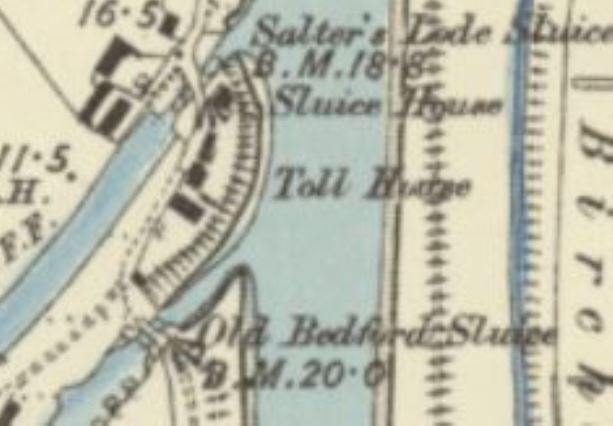 The 4 site maps above are extracts from the Ordnance Survey (OS) 6-inch to 1-mile scale "County" series of 1880, courtesy of National Library of Scotland
Rowbotham's published findings
Rowbotham published a number of papers and books detailing his findings but unfortunately some statements are somewhat inconsistent or confusing, as described later. 1865 book title page
 1881 edition title page
On page 11 of his 1865 publication "Zetectic Astronomy: Earth Not a Globe" Rowbotham states that his 1838 experiment was on six mile stretch from Welney Bridge looking towards Welches's Dam.
note, "Welney Bridge" is the name frequently but wrongly used for the Old Bedford Bridge at Welney, see Victorian map below
A boat, with a flag standing three feet above the water, was directed to sail from a place called “Welney Bridge” to another place called “Welches Dam”. These two points are six statute miles apart.whereas in the 1881 edition he says it was the other way round:
A boat, with a flag-staff, the top of the flag 5 feet above the surface of the water, was directed to sail from a place called “Welche's Dam” (a well-known ferry passage), to another called “Welney Bridge”. These two points are six statute miles apart.The latter is supported by other remarks in the book, e.g. when describing an incident when he was asked to look in the 'opposite direction' (presumably looking south from Welches Dam) and witnessed the apparent 'disappearance' of a vessel, which then reappeared a short time later. It seems the boat was simply out of sight while negotiating a small kink in the otherwise straight waterway. There is such a kink, known as "the Gullet", a litle south of Sutton Gault and 5.7 miles south west of Welches Dam. The two road bridges which block that view now were built since.
When describing his fifth and last experiment in 1870, it seems he used a different part of the River because he says he made his observations from a sluice bridge two miles from Downham Market railway station (which he had arrived at from London) and he describes barges entering the canal from the River Ouse bound for Ramsey (which is accessible by boat via the 40 foot River from Welches Dam). He must therefore have been looking from the Old Bedford Sluice at Salter's Lode (a hamlet to the east of Nordelph) towards Welney, which is also a distance of six miles.
The Bedford Level Experiments
The following article was written by my friend John Joworski, then Webmaster of the Nordelph Website, for posting on both our websites."The issue was the relatively straightforward one of whether the Earth was flat (as the Zetetics held) or round (the Globularists). It's tempting from the comfort of a 21st century scientific perspective to laugh at the Zetetics, but we should perhaps be inclined to a little humility. The Zetetic philosophy was essentially one of 'proceeding by inquiry', which meant that any proof that the Earth was round would have to be the result of an experiment, not simply calculation. The world looks flat (just as the sun seems to orbit the earth) so it should be presumed flat unless it could be demonstrated otherwise.
The first attempt at an experiment was in 1838, when one Samuel Birley Rowbotham ('Parallax') made observations along the Old Bedford River, one of Vermuyden's finest drainage constructions and which, from Welney, runs dead straight for six miles. [Welney webmaster's note: in both drections] Rowbotham was a convinced flat-earthist, which may have influenced his observational technique.
But nevertheless, from Welney Bridge (below) he clearly saw (through a telescope) barges on the river some six miles distant.
 Photo from Welney Website archives
In fact, because of the curvature of the earth, from ground level looking over a flat surface, you can see no more than three miles -- his barges should have been well below the horizon. The Zetetics concluded erroneously that the earth was flat, and everything went quiet until 1870..
There were doubtless many scientists around who could have pointed out that Rowbotham's results are comfortably explained by the refraction of light close to a warm surface, the basis of many desert mirages.
Note: John Harvey emailed in July 2018 saying that reference above to a warm surface is incorrect, and the explanation should read "by the refraction of light close to a cool surface (the water) which causes the light to be refracted downwards". John also gave a detailed explanation of this for which I'm grateful and which I'll try to make available later.Welney webmaster added to the story:
Experiment 2
A second experiment in 1838 used 6 flags placed a mile apart along the side of the river, each 5 feet above water level.
end of addition
Rowbotham is challenged, and wagers made
But no one seemed to have the stomach for more experimenting until Alfred Russel Wallace, noted for espousing the new theory of evolution and hence used to the impolite cut and thrust involved, set up a rather more elaborate experiment. In part, this was because one John Hampden of Swindon had underwritten a wager of some £500 [£1,000?] that a new experiment would establish the flatness of the earth for all time.Three barges were used, on each of which was erected a straight rod, all the same height. The barges were moored two miles from each other along the same stretch of water. The tops of the rods were thus all the same distance above the surface of the earth. Using a theodolite, Wallace sighted from the top of the first rod to the top of the third. If the earth was flat, the top of the middle rod would lie on the same line.
In fact, because the earth was curved, the third rod was lower than the second: the second marker was a clear 32 inches above the line from the first to the third (sometimes reported to be five feet -- doubtless to emphasise the clear victory for the Globularists).

This makes the diameter of the earth 7920 miles -- pretty good for 1870, as we now believe that the earth's equatorial diameter is 7926 miles (the earth isn't a perfect sphere, and has different diameters at different places).Unfortunately for Wallace, but fortunately for those of us who are enjoying the story, the Zetetics (also known as the 'planists', by the way) looked at the same results and somehow managed to convince themselves that a trick of perspective was involved and that this did, after all, prove that the earth was flat!
John Hampden refused to pay up, and the matter went to court some six years later. In a wonderful instance of jurisprudential cunning, the presiding judge declined to rule on what might be deduced from the experiments and contented himself with adjudging that such wagers were not legally binding!
Hampden responded badly to a verdict that had, after all, saved him £500. He became obsessed and conducted a campaign of vilification against Wallace for the rest of his life, which led to several prosecutions for libel and accompanying prison sentences. As so often happens when people disagree, neither side ever managed to convince the other -- indeed, the Flat Earth Society continued in being until the 1980's. It was later resurected, and in 2026 was still in existence.
What happened thereafter was that newcomers simply repeated the experiment associated with what they wanted to prove. In 1901, H. Yule Oldham repeated the Wallace experiment pretty exactly and got the same result, which he reported to the British Association for the Advancement of Science.
In 1904, a Lady Blount repeated essentially the Rowbotham experiment with the added value of new-fangled photography: at least her result was demonstrable, and didn't rely on hearsay. This time, she photographed a white sheet hanging two feet above the water, six miles away -- just as Rowbotham had (and for the same reasons) she could see the theoretically hidden bottom of the sheet, and what's more its reflection in the water!
We may laugh now, but it is hard to disbelieve the evidence of our eyes, and the Zetetics were not fools. One modern analogy might provoke some reflection. The Bedford Level experimenters used the river because it was flat and straight. As with us, they looked around and saw jagged mountains, ocean trenches and very little flatness -- the river was a godsend. But in fact, considering the scale, compared to a billiard ball the earth is several orders of magnitude smoother on its surface!"

cover of Rowbotham's 1870 book refers to a wager of £1,000
2015, a re-enactment (so called!)
Cambridge Archaeological Unit (CAU) were commissioned through lottery funding to re-enact Rowbotham's experiments (incorrectly calling them trials) as part of an Environment Agency (EA) "Ousefest" fun-day festival. The sign at the car-park should have pre-warned us they may not have got things quite right.
The sign seems to indicate a footpath over nice flat land for those unable to manage uneven ground rather than the way to a professional re-enactment.
The 'show' wasn't on the Old Bedford River, it was held on the Cut-Off Channel. They hadn't obtained a Victorian boat, just a glossy modern glass fibre EA motor launch, and instead of a hand-held Victorian telescope, they had a top-of-the-range digital surveying level mounted on a fancy tripod. Well, none of that really matters, does it?
Another thing CAU got wrong was the start time, it didn't happen until about an hour after the time specified.

Spectators waiting for something to happen Anon
 While we waited, in the cold, for some action long after it was due to start, a disheveled-looking man appeared in front
of us and without introduction spoke in a North American accent telling us what the "Bedford Level" trials were about.
While we waited, in the cold, for some action long after it was due to start, a disheveled-looking man appeared in front
of us and without introduction spoke in a North American accent telling us what the "Bedford Level" trials were about.He then walked away and we continued waiting and getting colder.
Half an hour later the launch appeared and moored up not far away. Then another long delay before they started the "trial". We then noticed that the object they were viewing through their surveyor's level wasn't a mile distant as in Rowbotham's second experiment, this was just a 100 yards or so away, with another just beyond.
We all felt cheated.

Two target flags on wooden pallets
The three guys next to my party were science professors from Cambridge University. They were even more scathing than we were.
Now, my apologies to Americans. The unknown speaker we later discovered was Canadian, and not a tramp but a celebrated archaeolologist, Dr. Chris Evans, head of the CAU, and he wasn't dressed in Victorian workman's costume, thats how he normally looks, as I discovered when I lunched with him a year later. But thats another story.
 Dr Evans re-enacted Rowbotham using a hand-held telescope to view boats and flags several miles away, with a tripod-mounted ultra-modern digital surveyor's level looking at objects just a hundred or so yards / meters away.
the 3 photos above and the trials/trails one are screenshots from the CAU video on You Tube
The whole so-called "re-enactment" event was a very disappointing un-professional mess from start to finish; CAU managed to get every single aspect wrong - even that sign.
Fortunately, the day got better.
I did my flat-earth spiel to camera, which was applauded by those watching.

Doing my flat-earth spiel to camera
And later had a ride in a very fast EA speedboat.

I was at the rear, far side, with my face covered by a camera taking photos of my friends on the bank, one of who was Mike Petty, the Cambridgeshire historian.
photos of filming and speedboat, courtesy Mike Petty
The Flat Earth Society described above may have died, but the name lives on in the form of a Belgium big band. Established in 1997, The Flat Earth
Society has performed in festivals across Europe, notable Bruges, Brusselles and Duisberg.
Appendix
Update, January 2010The (non-band) Flat Earth Society was 'resurrected' in 2004, and in October 2009 it re-opened to new members. In November 2009 Daniel Shenton, the President of the Society wrote to Welney Parish Council requesting permission to display a plaque on the Bedford Bridge commemorating the 1838 experiment. The matter was discussed at the Council's meeting in December 2009 and it was suggested he should contact the Highways dept [of Norfolk CC] who have jurisdiction over such matters. You can read more at item 11g in the Council's minutes. At the same meeting a letter from Russell Duffy regarding Mr Shenton's request was discussed. See item 11i in the same minutes.
Shortly after posting this update I learned that the Parish Council should have told Mr Shenton to contact the Bridges Department [of NorfolkCC] as it is they that deals with such matters, not Highways.
One of the Councillors, Mark Brown, wrote an article about the experiments published in the local bi-monthly parish magazine, Welney News, issue 75, June/July 2010.
Learn more of the Flat Earth Society at their own new website.
Further reading
A book by Christine Garwood, 2007, "FLAT EARTH History of an Infamous Idea" A very easy-to-read bulleted webpage with some nice diagrams of the experiments plus talk of a re-creating them (due in 2018) is at: Metabunk.org
Highly recomended.
Acknowledgements:
Thanks to Google for the e-version of Rowbotham's 1865 bookand sacred-texts.com for extracts from the 1881 revised edition
Other sources as noted.
Page and site designed and maintained by the Welney Webmaster, Peter Cox.© 2002-2026 Welney Website. If you wish to add, correct or disagree with anything, please e-mail and you comments will be added.
The Welney Website