FARMING IN WELNEY
Page good for smart-phones. On PCs/Laptops it may look too large. To reduce press "Ctrl" & "minus" or click "View" then "Zoom out"
Created Jan 2006, last edited: 19/03/26, 14:03
Created Jan 2006, last edited: 19/03/26, 14:03

Introduction
This is one of a series of pages about agriculture in Welney. This page takes us back to a by-gone age, but we have other pages that cover the 21st century - see links at bottom of page.In the "Old Days" - 1880 to 1980
This page describes some of the main changes in farming in this small part of the fens during the period covered - who owned and who farmed the lands, which crops were grown, what livestock reared, and the tools and implements used.It would need a book to tell the story in full; here is just a glimpse of farming life in Welney, using mostly local photographs and reminiscences.
For older site visitors, especially those with a rural background, do you recognise any of the items below ? This quiz was published in a Cambridgeshire Times farming review in 1973.

Landowners
In East Anglia generally the largest landowners at the start of this period were the Church of England; The Crown; Cambridge colleges; aristocracy; yeoman farmers; successors of the 'adventurers' (venture capitalists in todays jargon) who financed the draining of the fens; the authorities that maintained the drainage; private landowners large and small; and charities.However, that does not seem to be the case in Welney. In 1880 the parish of Welney was split almost evenly between the counties of Cambridgeshire and Norfolk, which makes research a little complicated, but the census of 1881 give an indication of the farmers at that time, but not necessarily whether they were owners or tenants.
Kelly's directory of 1883 listed the largest landowners as three members of the Beart family; James Morton of Welney House; William Little (mostly at 100 Foot Bank); and James Failes at Lakes End. The William Marshall Charity owned 440 acres rented out in 18 lots to the highest bidder. Earlier records (1850s) show the predominant landowners to be the Townleys, with the Huddlestones also substantial owners. (See the Church pages for more on those).
Scroll down to read on, or use the menu bar and choose a section to jump to. But please do read the whole page as soon as you can.
Smallholdings
In 1890 the Government recognised the difficulty for working class people to buy land and the shortage of holdings to rent at a reasonable price, and appointed a Select Committee to inquire into the creation of [more] 'small holdings'.The subsequent report led to the passing of the Small Holdings Act in 1892 which aimed to provide l and for labourers and encourage them to become small-holders (ie small farmers) so raising their status and slowing down migration from country to towns. Throughout much of England implementation of the act was slow, and a further act was passed in 1906.
In Norfolk, the Norfolk Small Holders Association (NSHA) was set up with private finance and bought three farms totally about 330 acres in 1900 which was rented out in small lots of up to 1 to 5 acres, but the County Council (NCC) was rathy tardy and didn't make its first purchase until 1904, the 90-acre Chapel Farm at nearby Nordelph, and only then following a petition organised by NSHA.
It was not until February 1910 that land was acquired in our area when the NCC bought White Hall Farm at Tipps End (a property in the region of 400 ? acres of which nearly half was actually in the county of The Isle of Ely). That land formed what became known as the "Welney Estate". Norfolk CC also acquired land at Manea Fifties in the Isle of Ely, bought (I think) just after the end of WW1.
Note: The Isle of Ely was a division of Cambridgeshire until 1888 but was then separated and given County status. It remained independant until 1965 when they re-merged as 'Cambridgeshire and the Isle of Ely'. In 1972 the new county was merged with 'Huntingdon and Peterborough' under the single name of Cambridgeshire. The merger of these four areas had been originally proposed 25 years earlier in 1947!During the early years of the 20th century the average holding was around 15 acres (6 hectares) with 30% of the tenancy applications coming from agricultural labourers, of the rest most were from small farmers seeking more land for their sons. In 1914 only 20% of the landholdings included a house.
Virtually every smallhoder would have kept livestock. Horses to haul implements and carts; at least one cow to provide dairy produce for the family, maybe a small herd to earn income; chickens of course, usually tended by the holder's wife, and posibly a few pigs. Many smallerholder's would have had another job, maybe labouring for a larger farmer, or as a publican, carter or blacksmith.
<.div>
THE AGE OF THE HORSE
Ploughing
These pictures show what many of us will think of as a typical farming scene of the past, the first part of land cultivation with a large powerfull 'draught' horse pulling a manually controlled plough.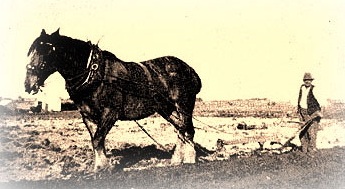

The first ploughs ('plows' in medieval England and modern America) were wooden, later with iron edges, then completely of iron, but by 1880 they would have been of steel like the single furrow one on the right. This would have been used by a smallholder with just a few acres in late Victorian times (and probably up the 1950s in some cases).
Larger farmers would have typically used a 3 furrow plough drawn by a team of four to six horses or maybe a six furrow plough hauled by steam powered machinery (as shown further down this page) until internal combustion farm tractors were introduced in the 1920s and 1930s.
The fertile arable land would have been used to grow wheat, beans and root crops such as potatoes and mangles, and the pastures in the Ouse washes provided good summer grazing for cattle and sheep.
Carts and Wagons (Waggons)
Carts have one axle, ie two-wheels, and drawn by a single horse. Wagons or waggons have 2 axles, ie 4 wheels and need a pair.Carts and wagons when new were often ornately decorated and sign written with owner and makers names. I don't think many were re-painted. Counties or regions had their own standard of sizes and construction.

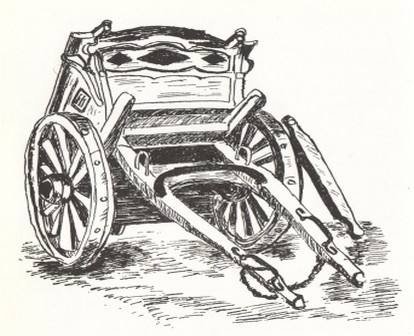
On the left is a tipping cart. The tipping mechanism is not clearly visible, but the body (or 'buck') appears to be held down by two hinged metal staples on the shafts which fit over lugs protruding from the body.
On right, a tipped-cart, a Suffolk Tumbril. The body on this was held in position by a rod (shown removed and leaning against a wheel) which went through two fixed staples and over the protruding parts of the body.
Cissie Bedford and her brother with horse drawn waggon
 The Bedford's were a large Welney family. Cissie was Welney's oldest resident when she died in April 2015.
If you know when and where the photo was taken, please let me know.
I assume the Bedford's waggon was a Norfolk design. If so, I'm told it would have been cross boarded, with side panels and wooden axles, but if anyone knows differently, please let me know.
photo from the Welney MAP 2000 Welney Archives CD.
Text © Welney Webmaster 20010.
Drawings below are of waggons from a neighbouring counties. Left, Northamptonshire , spindle sides, long boarded, iron axles. Right, Lincolnshire, similar construction but with timber axles.


Below, left, "East-Anglian" waggon, made in Essex c1850. Right, Norfolk waggon.
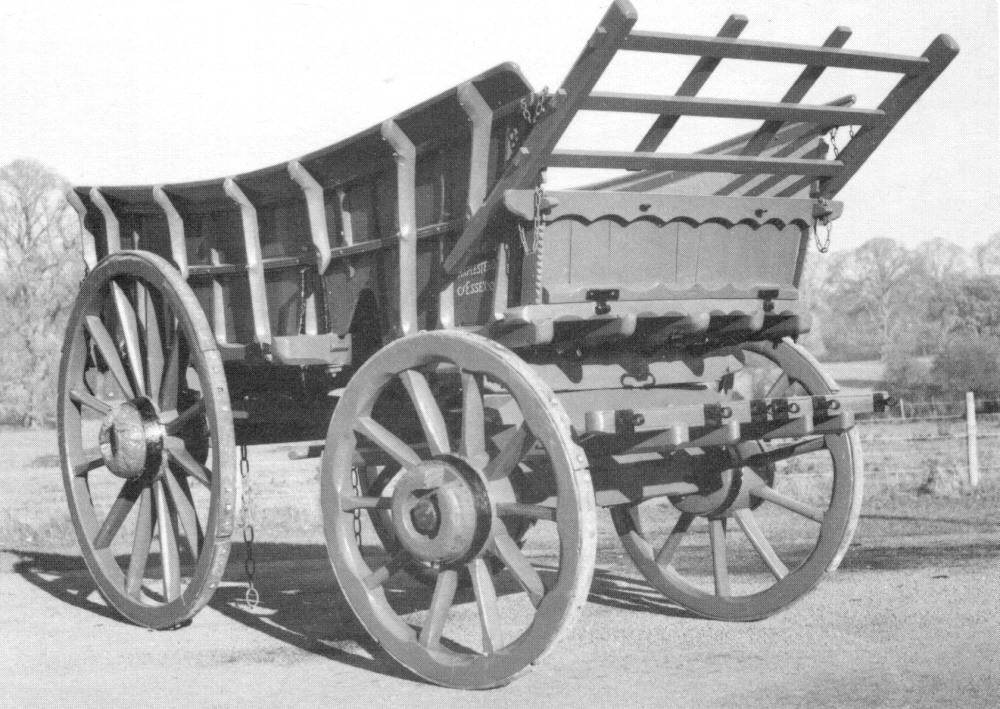
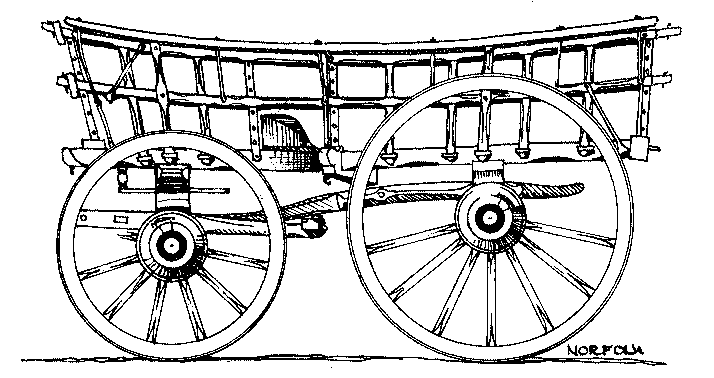
I've not found any mention of Cambridgeshire or Isle of Ely wagons. If you know of any please let me know.
Carting and stacking sheaves in 1935

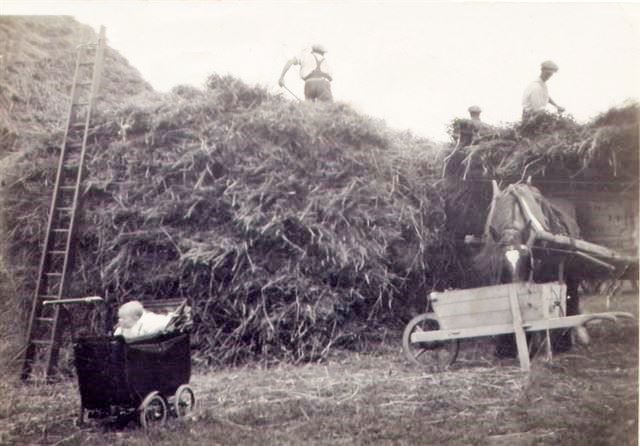
Proabably at the Markham's NCC holding at Manea Runs with a very young Amy Markham in a non-farm vehicle. Was the woman in the wide brimmed hat in the first photo her mother?
Photos taken in 1935, but many smallholders were still using horse drawn carts in the 1950s. After horses were retired, the carts would still be used, modified to be towed by a tractor.
photos above courtesy of Miss Amy Markham, MBE. Text © Welney Webmaster 2006
THE AGE OF STEAM
Traction Engines
George Smart's steam-powered traction engine, c1915
 George Smart was a son of the famous fen skater William "Turkey" Smart.
Left to right, on ground: Tom Carter, Jarman Smart, George Smart, George Cutting, Bob Gordon, Fred and Jim Carter.
Above: Ike See at wheel, Herbert James Smart (George's son, K.I.A in France 25 March 1918 whilst serving in the Army Service Corps as an engine driver), anon and Daniel "Doddy" Rudland (engine driver).
Steam traction engines like these were built from the 1850s up to about 1937 by many companies including Gibbons & Robinson, Fowlers of Leeds, Foden, Aveling & Porter, Ruston Proctor, Robey & Co, Chas. Burrell of Thetford, Garrett, Ransomes Sims & Jeffries of Ipswich, Ruston& Hornsby, and Wm.Allchin.
This one powered threshing machines (see below). Others had a drum-winch underneath and were used in pairs as ploughing engines.
photos & names above courtesy of Miss Amy Markham, OBE and Mr Tony Smart.
Text © Welney Webmaster 2006
THE AGE OF THE INTERNAL COMBUSTION ENGINE
There were several makes of petrol, paraffin and diesel engined tractors around Welney in the 1940s-1960s, but two were particularly well known and respected, Fordson and Ferguson. This is the story of 3 tractors with connections to the webmaster's home since 1990, White Hall Farm in Tipps EndFordson
 The tractor here, registration JEB 30, is a Fordson model N, produced between 1939 and 1945. In 1940 the rear mudguards were changed to the shape in the photo below, so this is an early version.
Seen here with brothers Len and Keith Markham at White Hall Farm in the 1950s towing a reaper-binder, which cut the corn and bound it into bundles called 'sheaves'
I think it would have been a bright orange colour all over with the 'Fordson' names at the top and sides of the radiator in black.
It had a 28 hp engine and two fuel tanks. It was started using petrol, and when warm was switched over to cheaper fuel known as "TVO", tractor vaporising oil, a type of paraffin or kerosene.
 This is a Fordson Major, model E27N, introduced in 1945 as the successor to the Model N above. The engine and gearbox were the same as the earlier model N, but the colour was completely different - dark blue engine, chassis and bodywork and dark orange wheels with the 'Fordson' names at top and sides of radiator also orange. It was a bit crude, but reliable and very cheap.
Above at White Hall Farm with neighbour Trevor Loveday on tractor, and various Markham children by the reaper (Keith on top).
Below, Trevor Loveday on tractor, Fred Markham on reaper

The cutting and binding mechanisms on some reaper-binders were powered via a drive shaft from the tractor's rear PTO (power take off) to the reaper gearbox. Others were chain driven from a large wheel under the reaper.
If you know, please e-mail the webmaster
Later note, 9th March 2007. Michael O'Neill e-mailed from Co. Cork in Ireland to say that he has a Hornsby reaper and binder, c1940, chain driven from a ground wheel, and the one in this photo seems to be the same.The sheaves in the foreground would later have to be picked up and stood upright in small groups known as 'stooks' to dry out before being carted off to the stack yard, or rickyard. Many of these tractors would have had another PTO in the form of a drum on the right side of the gearbox used to drive threshing machines via a long leather belt, but this tractor does not appear to have one.
The Webmaster has fond memories of Fordson Majors. He learned to drive on one while on holiday from London aged 12 on his uncle's smallholding in Crowland, Lincs. He drove one every Easter and harvest time for the following 10 years. He was not so fond of the hard work involved in stooking, and later loading sheaves onto trailers.
Fordson photos above courtesy of the late Miss Amy Markham, MBE. Text © Welney Webmaster 2006
Ferguson
The TE series of tractors designed by Harry Ferguson and built in the Standard Motor Company factory in Coventry were introduced in 1947 and are affectionately known as "little grey Fergies".The design was revolutionary because they were the first to have a hydraulically-operated three-point rear implement hitch and automatic depth control. (Now isn't that interesting?)
Considered by some farmers to be too small to tackle heavy fen soils, their versatility, ease of operation, and light weight soon made them popular with others. I understand that one large local farmer (Hartleys) had over 20 during the 1950s and 60s.
A wide range of Ferguson-designed attachments were available enabling the tractor to perform just about every job on a farm.
The story of little grey Fergie DJE 468
DJE 468 is a 1954 diesel model originally owned by a large March-based farming company.In 1958 it was sold to John Biggs of Two Ways, Lakes End, who kept it until his retirement in 1965. It then had a number of local owners, including Hartleys until about 2000, then Bernie Markham and in 2006 was acquired by the webmaster (Peter Cox).


Photos: on left in 1965 at Biggs' farm sale with a young John Loveday on board. John was elected to Welney Parish Council in May 2019, topping the polls, and was appointed Chairman

Right, and above right, in 2008 in the Webmaster's back-garden at White Hall Farmhouse with a Ferguson disc harrow fitted, but missing its original high-level single headiamp.
photo above left, courtesy John Loveday; colour photos by Peter Cox
THRESHING MACHINES
Threshing machine, or thrashing drum, somewhere in Welney, possibly mid-1930s?
 These machines were driven by a leather belt from an engine such as the one above, or by a tractor, as here. It needed a team of eight men
to operate it, and more to look after the power source.
These machines were driven by a leather belt from an engine such as the one above, or by a tractor, as here. It needed a team of eight men
to operate it, and more to look after the power source.The sheaves, which would have been stacked for several months to dry out, were pitch-forked up to the top of the machine and fed into the threshing drum.
The grain poured into sacks which held 2 cwt (224lb or 102kg) and the much lighter chaff was collected separately. The straw passed out of the front of the machine on a series of mechanical ratchets called 'straw-walkers' and built into stacks. This machine was built by Marshall, Sons & Co. Ltd of Gainsborough, Lincs. Note the metal wheels on tractor and thresher.
photo above from the Welney MAP 2000 Welney Archives CD. Text © Welney Webmaster 2006.
Later note, 12th March 2010. Alan Mitchell e-mailed from Shepton Mallet in Somerset to point out that
"sacks of barley were 2 cwt, but wheat was in 18 stone (252lbs, 114 kg) bags and oats 12 stone (168 lbs, 76kg). This follows from all grain being sold by the bushel and quarter which were volume weights. Grain sacks were hired – all one size – from Sack Hire companies who had bases at the Railway stations across the country.These hessian bags were designed to hold half a quarter of grain with barley being 32 stones to a quarter, wheat 36 stones and oats I think 24 stones; the oats were certainly held in 12 stone weight. This did not change until mobile weighing machine became available in the 19th century."
Threshing mustard at Cecil Mott's farm in the Littleport fens, in 1930s
 Threshing machines were not just for cereal crops. The machine was driven by a leather belt from the steam engine on the right
The mustard would probably have gone to Colman's in Norwich
The Mott family had (and still have) a number of farms on the east side of the Hundred Foot River with lands in both Welney and Littleport, including Dairy Houses Farm and Four Balls Farm
photo and heading above from 'Fenland Today' April 1991
Women field-workers, 1950s ?
 From the previous photos you might have thought that farming was a man's world, but women played a big role too.
 This was particularly so during the two world wars when women from urban areas were recruited into the "Womens Land Army" to replace men called up to fight.
Local women, often the wives and daughters of farmers and smallholders, had of course worked on the land throughout this whole period until mechanisation took their jobs away, or they found easier and better paid work elsewhere.
Pictured here are (left to right) Blanche Markham, Elsie Gordon, Miss Trower, Hilda ? and Grace Bedford.
The baskets may look like modern-day supermarket ones but in fact the ladies were picking potatoes.
photo above from the Welney MAP 2000 Welney Archives CD.
Names supplied by WASH Committee as shown in the Welney News, issue 55.
Text © Welney Webmaster 2010.
Later note, 22nd Apr 2010. Tony Smart from Cambridge e-mailed to say that he's sure the lady second from right is actually Daisy Watson (wife of Herbie) and that the person who supplied the original info' may have confused her with Hilda Watson; both lived in Chestnut Avenue, Welney.
A smartly dressed milkmaid ?
 Probably not. I understand this was an aunt in her 'Sunday-best' clothes visiting her relatives at White Hall Farm.
photo from the Welney MAP 2000 Welney Archives CD. Text © Welney Webmaster 2010.
Mrs E. Daisley of Tipps End planting celery in 1955
 Here, Mrs Daisley was one of a gang of women landworkers working for gangmaster Derek Mason, planting celery seedlings in Wisbech for FW Williams Ltd.
Most of the women worked laying down on chitting trays covered with sacks of straw for padding, although some preferred to kneel. Each woman worked a strip of land marked off with twine, planting "29 seedlings in a 24 inch wide row".
Experienced workers could plant up to 7,000 seedlings a day using a small dibber, but probably had to work until 7.30pm to do that. The average was a mere 4,000 !
Back home, Mrs Daisley tended her own three acres of land in Tipps End.
Photo and details above from an article in the Isle of Ely & Wisbech Advertiser Saturday Pictorial, 30th April 1955. The article gave Mrs. Daisley's age as 70, but if this is the same Edith Daisley who was buried in Welney St Mary's Church in 1966 aged 71, then she would have been (only!) 60 years old.
Charlie Kent with his thatched corn ricks in 1973
 Charlie was born and bred in Welney and worked on the land since he was 14, for many years with Headings based at Colony Farm before moving to Hartleys in 1953.
His speciality was thatching, and although much of Hartley's corn was combined, they still harvested a small amount each year in the old-fashioned way. The resultant sheaves were built into round stacks which Charlie would cover with thatch to waterproof them, finishing off with a little top-knot.
The clusters of ricks were a familiar site in Welney and Lakes End, and a reminder of how things used to be done.
He was sixty years old when this photgraph was taken and still living in Welney, in Wisbech Road, with his wife Carrie.
Photo by Peter Cook. Text based on an article in the Cambridgeshire Times Agricultural Review, Autumn 1973
Later note, 22nd Apr 2010. Tony Smart from Cambridge e-mailed to say that Charlie Kent was once the landlord of the Three Tunns pub on Bedford Bank, Welney, and had also been a grave-digger.
early combined harvester
 I didn't have any details of this machine when I first posted this page in 2006 and asked anyone who did to e-mail me
webmaster.
I didn't have any details of this machine when I first posted this page in 2006 and asked anyone who did to e-mail me
webmaster.Sept 2015 update 8 years after posting my plea, John Gilmour kindly responded:
"Hi, this combine is a CLAAS Super, trailed combine (it was pulled by a tractor) We used one of these machines from 1951. I expect you will have had many confirmations of all the details including the spelling of the name Claas. They are built in Germany, and are still one of the leading makes."John's comment confirms the earliest combines were towed or trailed, not self propelled.
In Norfolk, one of the earliest to be used was a 1932 International 31T bought by Mr Foster Harrison of Brandon Parva in 1935 and used until 1965 after which it was left in a barn. Mr Foster's son Lewis put it up for auction in 2010 having decided he didn't, after all, have the time to restore it!
photo from the Welney MAP 2000 Welney Archives CD. Text © Welney Webmaster 2006.
Sugar Beet
in 1880, sugar-beet was grown widely in continental Europe but it was not introduced into Great Britain until the First World war. Norfolk was the first county to grow the crop and the first processing plant was at Cantley on the River Yare, built in 1912. Beet became a major earner for farmers, and a major nuisance for motorists. This was a 1973 advert by seed producers Miln Marsters, then of Kings Lynn. "Sing a song of Sweetnesss, A lorry load of beet, going to the factory...., with Monotri so sweet, when they test the sugar, they'll find it very high, And pay you loads of money, So grow more Monotri"
Many non farmers might put another way, "Loads of money for the farmer, roads of mud for the motorist".
For a simplified view of how beet becomes sugar, click here.
Sugar beet grown in this area is processed at British Sugar's Wissington factory. They have produced an excellent and comprehensive brochure. showing the complete process from field to finished product, and all the by-products, too.
Onions, coleseed, rape seed, and herbage were all grown in small amounts.
Land owners
At the end of the period covered on this page, the largest landowners in our area were probably conservation organisations. In 1964-65 the Cambridgeshire Wildlife Trust and the Royal Society for Protection of Birds (RSPB) began acquiring land in the Ouse Washes between Welney and Earith (now they own most of it) and in 1970 what is now the Wildfowl and Wetlands Trust (WWT) established a 900 acre reserve in the Washes a mile or so north of Welney.
The rivers and embankments enclosing the Washes have been owned and controlled by regulatory bodies primarily
concerned with drainage, navigation and water supply (including irrigation). For many years this was the Great Ouse
River Board which became the Great Ouse River Authority in 1965 (under an act of 1963) then the Great Ouse
Water Authority in 1973. (Ownership has changed again twice since then, as will be shown later on another web page).
Throughout those changes the washes and river banks continued to be grazed (usually between May and November)
and the RSPB actually provide stock management for over 2,000 cattle on behalf of the owners. These conservation
and regulatory organisations would have owned about 80% of the Washes in 1980, the remainder being in the hands of
wildfowling clubs and private owners.
Outside the washes, it is still difficult to determine land ownership. The biggest farmers on the east of the Washes included the Lees and Motts, whilst the the Headings and the Hartleys farmed much of the land to the west of our area, and the Norfolk County Council (NCC) still owned a large small-holdings estate in Tipps End. In 1980 there were I believe five main NCC tenants each with a holding of 50-60 acres and an NCC house or one of the 4 bungalows built c1958 (and several more holdings of 2 to 11 acres without a home). Few would have had any livestock.
Outside the washes, it is still difficult to determine land ownership. The biggest farmers on the east of the Washes included the Lees and Motts, whilst the the Headings and the Hartleys farmed much of the land to the west of our area, and the Norfolk County Council (NCC) still owned a large small-holdings estate in Tipps End. In 1980 there were I believe five main NCC tenants each with a holding of 50-60 acres and an NCC house or one of the 4 bungalows built c1958 (and several more holdings of 2 to 11 acres without a home). Few would have had any livestock.
Answers to quiz:
- Hand Barrow. For lifting sacks of corn onto a man's back or onto a cart.
- Hobby Rake. For raking stubbles after corn had been mown with a sickle or scythe.
- Sheaf Gauge. When corn was cut by hand, this was used to esure that sheaves were the required size
- Bushel and Strike. The imperial bushel was the official measure for grain (see Alan Mitchell's comments above)
The strike was drawn across the top to level off the contents. - Flail, Poverty Stick, or Stick and a Half. For threshing grain by hand.
- Barley Humler. For removing awns from barley after threshing by flail.
- Throw-Crook. Fr twisting straw into rope
- Staddle Stone. Supports for granaries and stacks to keep them off the ground to allow air flow and also keep rats and mice out.
Acknowledgements:
Newspaper cuttings and quiz courtesy of the late Bernie MarkhamOther sources as noted.
Page and site designed and maintained by the Welney Webmaster, Peter Cox.© 2002-2026 Welney Website. If you wish to add, correct or disagree with anything, please e-mail and you comments will be added.
The Welney Website