
The Welney Website
Aircraft crashes in or near Welney in WW2
page created 31st July 2010; last updated Thursday, 09 October 2014
INTRODUCTION
A number of aircraft accidents occurred locally during WW2. Some have been fully or partially investigated, others are just vaguely remembered. The late Ernie James, a well known Welney wildfowler, ferry operator, raconteur and 'fen-tiger' recalled a number of wartime incidents in a book 'Memoirs of a Fen Tiger' written in 1986 by his daughter-in-law, Audrey. These included:- A Mustang that flew low over him and jettisoned two fuel tanks. One exploded on impact, the other was empty, and Ernie took it home and planted flowers in it. (No date or exact location given)
- A Lancaster bomber that crashed in the washes; Ernie found some tiny fragments blown off on impact. (No date or exact location given)
- A Heinkel shot down by an RAF plane crashed in flames in the washes. The crew had baled out, the pilot gave himself up at Suspension Bridge and the others were picked-up later. (No date or exact location given)
- A Wellington bomber incident in 1941 which Ernie described in some detail. See report, link below.
|
|
A very comprehensively investigated incident was the crash of a Halifax bomber just over the Welney border at Colony Farm, Manea in 1944, researched by Michael Harrison.
Various voluntary aircraft reaseach groups have physically investigated crashes all around the area, and there are many websites showing details from offical records and personal accounts. Jeff Carless of East Anglian Aircraft Research Group has been particularly helpful and has supplied information (some very detailed) on several crashes and has corrected errors on some earlier postings.
CRASHED AIRCRAFT and LOCATIONS
The accidents that this website has information about are listed below. Click the aircaft type to view the report and associated links.| date | make | type | s/no and code | force | crash-site |
| 4th Jan 1941 | Hawker | Hurricane | L1741 code n/a |
British | NE of Wry Necked Mill |
| 10th Feb 1941 | Vickers | Wellington Mk. 1C | T2888 R-LN |
British | Stags Holt. Crew bailed-out over Welney Washes |
| 2nd May 1941 | Junkers | JU88 A-5 | 4269 3Z+CL |
German | Welney Washes (?) |
| 6th Nov 1941 | Hawker | Hurricane | V7004 code n/a |
British | East of Cock Fen Farm |
| 25th Nov 1941 | Hawker | Hurricane | P2822 code n/a |
British | SW of Old Fm, Cock Fen |
| 13th Jun 1942 | Hawker | Typhoon Mk.1b | R7618 code n/a |
British | Butchers Hill Farm |
| 24th Nov1943 | Avro | Lancaster Mk.111 | MG-J2 JA971 |
British | Lady Fen Fm |
| 25th Apr 1944 | Handley- Page | Halifax Mk.111 | LK789 MP-L |
British | SE of Colony Farm |
| 22nd June 1945 | NAA | Mustang P51B | 2-106-638 E9*B (R?) |
American | Hilgay Fen |
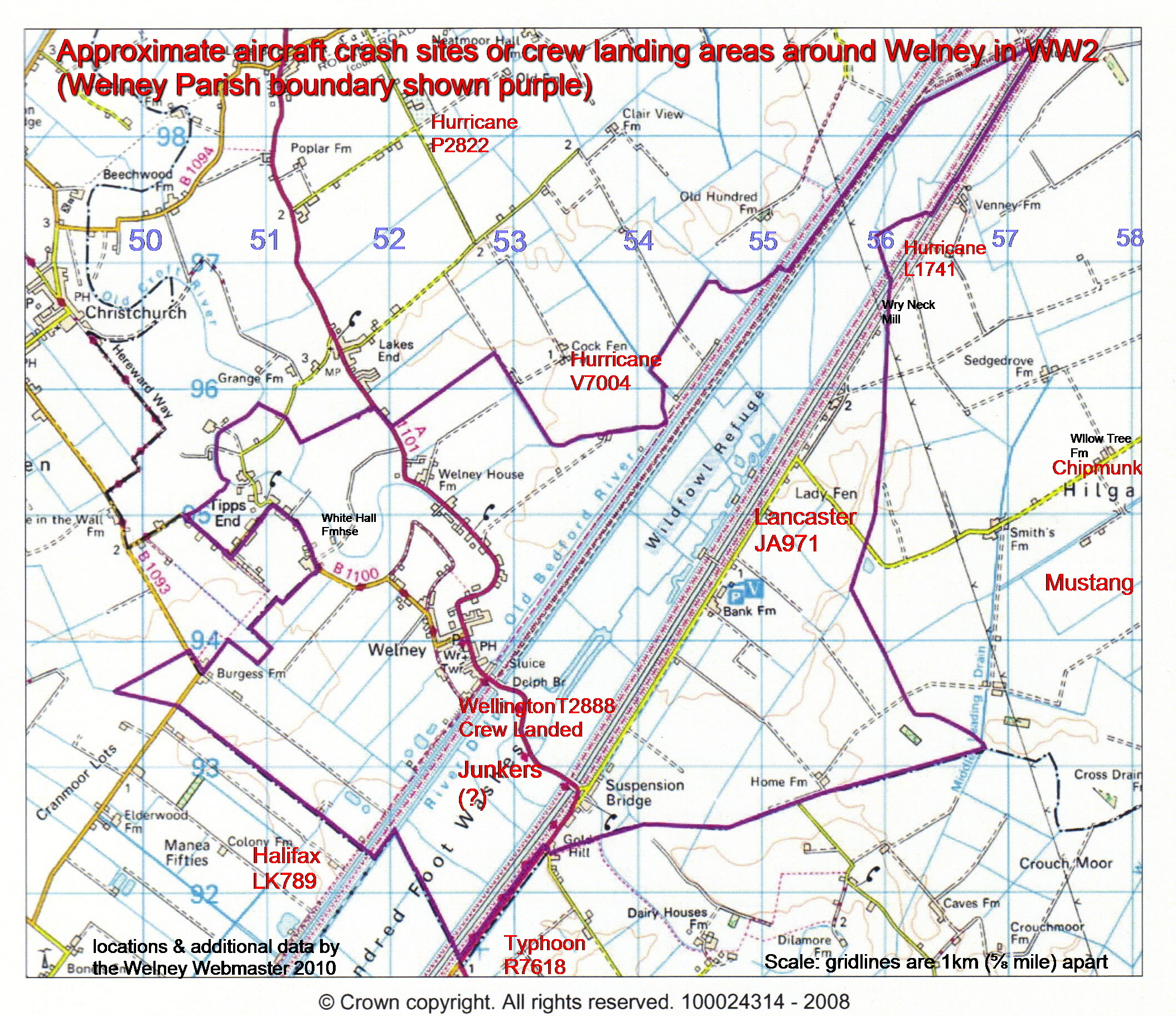
APPROXIMATE sites of crashes - this is a large file and may take a while to display. Click to enlarge in new window or tab. If you would like exact locations please contact Webmaster.
back to top of page
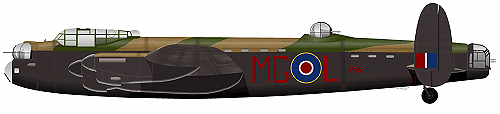
RAF Stirling coded MG-L
s/no P8623, "L Love", of 56 Sqn
Bomber Command.
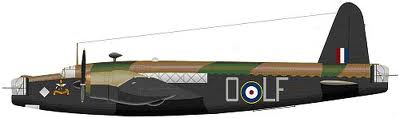
RAF Wellington coded O-LF
"O Orange" of 37 Sqn
Bomber Command.

USAAF P51B Mustang coded QP-N
"N Nuts (?)" of 334th Fighter Sqn
4th Fighter Grp, 8th Air Force
(under RAF control)
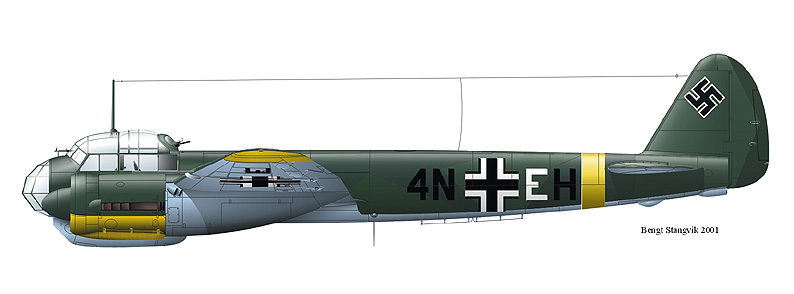
Luftwaffe Ju88 coded 4N+EH
"E Emil" of 1. Staffel (H)
Aufklärungsgruppe 22 (4N)
WW2 AIRCRAFT IDENTITY CODE MARKS
RAF aircraft had a 3-letter code painted each side of the fuselage, 2 letters indicating the squadron, the other the individual aircraft, the two parts separated by the RAF roundel (which had an extra yellow outer ring).These codes were also used by the RCAF, SAAF, RNZAF, and for a while after America joined in the war, by USAAF units of the 8th and 9th AF. Later, the USAAF codes changed to a completely different system as the number of craft and units increased.
The single letter also indicated the aircraft's call sign, which would have been a name or word from the phonetic alphabet of the time - in the table above, the Wellington was called "R - Robert". (Phonetic alphabets varied, there was no standardisation in those days, see link on right.)
Very occasionally the single letter would have been followed by a single-digit number, painted much smaller than the letters. It indicated an additional or replacement aircraft. Sometimes the aircraft serial number was shown, also very small (see MG-L on left).
German aircraft had 3 letters and one number - see link on right for details.
|
In the 1969 film 'Battle of Britain' the producers insisted that the aircraft should look as authentic as possible. The exception was the code marks. They realised it would be impossible to portray every unit that took part in hostilities and it was decided to use fictitious code letters for the RAF aircraft, thereby apportioning no glory or blame to any particular RAF squadron. |
LINKS
Many of the links I originally posted are no longer working. One is Lostbombers.co.uk which had a very useful searchable database. There was a lot of controversy about that site contravening copywrite or intelectual property - see link to forum. A new similar site, Lostaircraft.com run from Germany, may be useful so I have added a link to it.|
Acknowledgements: Sources as noted. Text, design and layout: Peter Cox © 2013 Welney Website |
Codes could be changed or re-allocated.